
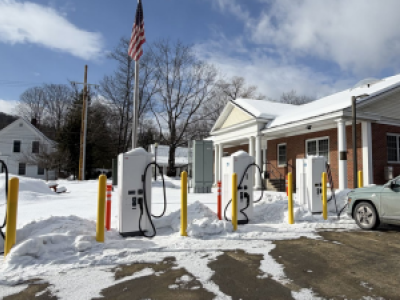
The Infrastructure Investment and Jobs Act, signed into law on November 15, 2021, established the National Electric Vehicle Infrastructure (NEVI) Formula Program to provide dedicated funding to states to deploy electric vehicle charging infrastructure along key interstate and state highway corridors. The goal of the Program is to create a reliable, convenient network of fast EV charging stations for drivers nationwide in order to help speed the adoption of electric vehicles and increase equitable access to infrastructure and economic opportunity. The Vermont Agency of Transportation and Drive Electric Vermont have teamed up to identify potential sites to install EV charging stations.
Become an EV Charging Site Host
To identify potential site host locations for future charging stations, AOT and Drive Electric Vermont(opens in a new tab) released an updated survey targeted to property and business owners (including municipalities) interested having electric vehicle charging infrastructure installed at their location.
Those interested in becoming an EV charging site host should first learn about some of the benefits and criteria related to hosting EV charging on site(opens in a new tab). Then fill out the survey(opens in a new tab) to provide basic details about the site. Responses will be shared with AOT’s prequalified EV charging providers who may reach out directly to discuss charging opportunities. Site hosts qualify for financial support for installation, equipment, and operations of EV charging stations if selected to host a station.
Key Considerations for Becoming a Site Host
- Location:
- For sites located within 1-3 miles of interstate exits or key state highways (I-89, I-91, I-93, US 2, US 7, VT 9), a minimum of four DC Fast Charging (DCFC) ports is required.
- Sites located further than 3 miles from these highway corridors will also be considered. A minimum of four ports is required. All four ports can be DC fast charging (minimum 150 kW) or can be AC Level 2 chargers, or a combination of both.
- Ports & Parking Spaces: Each location must provide space for a minimum of four charging ports. This typically requires about five parking spaces with an area nearby for electrical infrastructure.
- Safety & Security: Sites should be visible, with dusk-to-dawn lighting, in well-trafficked areas to prevent vandalism and ensure user safety. Security cameras or on-site staff are recommended. Reliable cell phone service is another important consideration.
- Amenities: The chargers should be available for public use 24 hours a day, 7 days a week. Proximity to amenities like restrooms, food, trash cans, and/or Wi-Fi enhance the user experience.
- Accessibility: At least one Americans with Disabilities Act (ADA) compliant parking space with charging access is required. Charging sites should also accommodate different vehicle types, such as those with trailers, using pull-through spaces where possible
- Future-Proofing: Locations with adequate physical space and electrical capacity may consider “make-ready” work to allow for potential future expansion with more charging ports.
- Resilience: Consideration for operations during extreme weather events and emergencies is encouraged. Parking spaces used for EV charging should be located outside of flood zones, regularly cleared of ice and snow, and in a generally protected area.
Apply to be a Site Host Today
If you are a property owner and interested in hosting a public EV charging installation, please complete this survey: https://arcg.is/1evL5j1.
Responses will be shared with AOT’s prequalified charging providers who may reach out directly to discuss charging opportunities.
Learn More
To learn more about this program and for an EV Charging Site Host Overview, visit National Electric Vehicle Infrastructure Program | Agency of Transportation.