
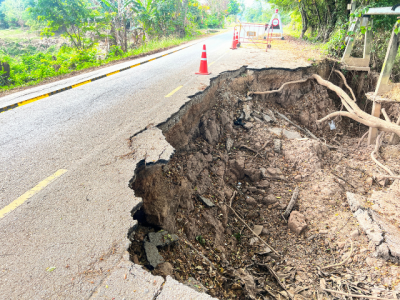
The Building Resilient Infrastructure and Communities (BRIC) program makes federal funds available for hazard mitigation activities that promote resilience with respect to natural hazards. BRIC aims to save lives, protect property, and reduce the cost of future disaster response and recovery.
What This Program Funds
BRIC supports hazard mitigation activities with the goal of lowering future disaster costs. Eligible activities includes:
- Project Scoping for a Specific Infrastructure: Can be used for a specific structure, like a bridge or culvert, or for a larger area (e.g. floodplain restoration). Scoping projects typically include an analysis of alternatives, public outreach, designs (up to 100% bid documents), environmental and historic preservation analysis (EHP), cost estimate, scope for final design and construction, and Benefit-Cost Analysis (BCA) for the preferred alternative.
- Infrastructure Projects: Such as floodplain restoration, culvert upsizing, dam or bridge removal, road relocations, streambank and soil stabilization, utility or municipal floodproofing projects. Only infrastructure projects that have at least a conceptual design are eligible; phased projects are not eligible.
- Building Code Plus-Ups: Mitigation activities that carry out eligible building code adoption and enforcement activities, such as: evaluating adoption and/or implementation of codes that reduce risk; enhancing existing adopted codes to incorporate more current requirements or higher standards; and developing professional workforce capabilities relating to building codes through technical assistance and training.
- Management Costs: 5% of total project costs will be available for managing the grant award.
How Your Community Applies
BRIC projects are reviewed and prioritized by VEM before submission to FEMA. The VEM Notice of Interest is due by 04/17/26. VEM then will invite some project applicants to submit FEMA applications by 05/15/26. Applicants invited to submit full applications can request technical assistance for the application.
Make Your Community’s Application Competitive
- The project area must have an approved Local Hazard Mitigation Plan at the time of application submittal and project award.
- Infrastructure projects that demonstrate high readiness are more competitive. For instance, projects with detailed designs will be ranked higher by FEMA than projects with conceptual designs.
- Projects should reduce risk and increase resilience, manage costs and schedules effectively, incorporate innovative techniques, and have a strong technical and managerial team.
- Projects from Economically Disadvantaged Rural Communities that meet application requirements receive 5 additional points in the application scoring process.
- FEMA recently added a requirement for BRIC subapplicants to provide basic information about their organizational leadership and governance structure. This includes a brief organizational description, a list of key leadership and governing body members, and short resumes for staff responsible for administering or implementing the project. A template captures this information.
Where You Can Learn More
If you have questions or you would like to discuss a project idea, reach out to DPS.HazardMitigation@vermont.gov.
Full details about the grant program can be found at https://vem.vermont.gov/non-disaster-based-funding.
The federal Notice of Funding Opportunity can be found at https://vem.vermont.gov/sites/demhs/files/documents/FY_20242025_BRIC_NOFO_Final.pdf.
Find Grant Writing or Grant/Project Management Help
VLCT published a resource, Increasing Municipal Capacity for Grants, that offers ideas for assistance with grants. Many of the capacity builders also provide project management services. Hiring experienced project management assistance can increase the speed of project development and help avoid cost, permitting, and other development surprises.