
The purpose of this web page is to keep members informed about negotiations that may lead to changes to the relationship between VLCT, PACIF, and VERB.
In December of 2025, the boards of directors of PACIF and VERB surprised VLCT by declining to renew their customary full-year funding agreements for services. Since then, at the request of PACIF and VERB Board Members, a working group consisting of VLCT, PACIF and VERB Board Members has met nine times, including nearly 20 hours in executive session, to negotiate a change to our administrative service agreements. The following Board Members currently serve on the working group:
VLCT Board Representatives
- Jessie Baker, South Burlington City Manager, VLCT Board Immediate Past President
- Mary Ann Goulette, West Rutland Town Manager, VLCT President
- Charlie Hancock, Montgomery Selectboard Chair, VLCT Vice President
- Karen Barber, Huntington Selectboard Chair, VLCT Board Member, PACIF Board Member
- Michael Hogan, Cabot Selectboard Chair, VLCT Board Member
PACIF and VERB Board Members
- Aaron Frank, Colchester Town Manager, PACIF Board President
- Bruce Urie, Craftsbury Selectboard Chair, PACIF Vice President, VERB Board Member
- Erik Wells, Williston Town Manager, PACIF Secretary/Treasurer
- Judy Frazier, Proctor Town Manager, PACIF Board Member
- Todd Odit, Hinesburg Town Manager, PACIF Board Member, VERB Secretary / Treasurer
The VLCT/PACIF/VERB Working Group has met nine times. Agendas and minutes for these meetings can be found on the board websites:
- VLCT Board | Vermont League of Cities and Towns(opens in a new tab)
- VERB Board | Vermont League of Cities and Towns(opens in a new tab)
- PACIF Board | Vermont League of Cities and Towns(opens in a new tab)
11/12/2026 Update
VLCT Board Receives Update on Negotiations and Reports From Executive Director.
See the teal Related Links panel on this page for more information.
FAQs
What are PACIF and VERB?
The Property and Casualty Intermunicipal Fund (PACIF) and the VLCT Employment Resource and Benefits Trust (VERB) are the two non-profit, member-owned risk-sharing trusts established by VLCT members to meet their particular insurance needs. With these VLCT trusts, even the smallest Vermont municipalities have access to a unique combination of coverage and services, many of which can only be garnered by a large group. Each trust has a Board of Directors that provides leadership and governance of the trusts, and VLCT administers the day-to-day operations of the trusts through administrative support services agreements with each trust. To help administer the trusts, VLCT hires experienced professionals who understand the distinct operations and risk exposures of Vermont municipal entities and are truly dedicated to serving members. Learn more about these trusts on our Risk Management Services(opens in a new tab) webpage.
What is the relationship between VLCT, PACIF and VERB? 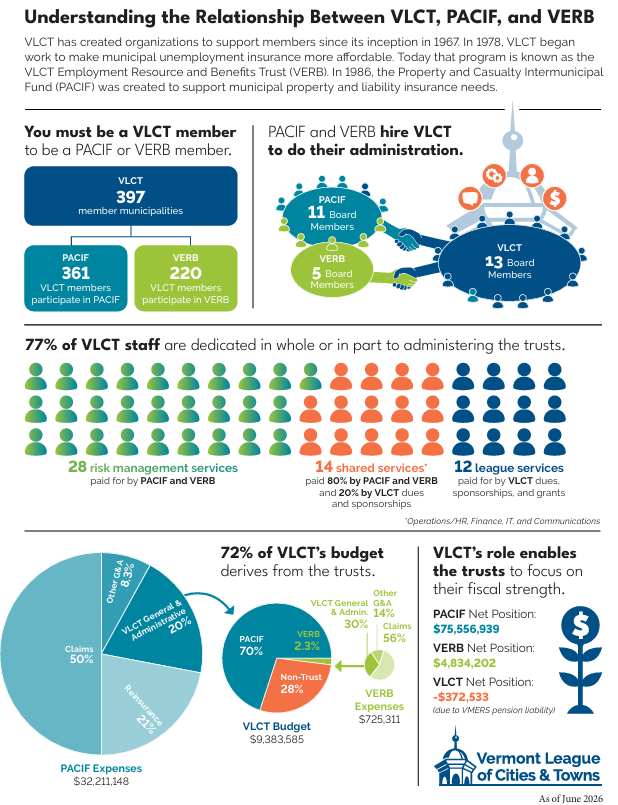
Forty years ago, VLCT created a government risk pool to address a crisis in the property, casualty and liability insurance markets putting our cities and towns at grave financial risk – the Property and Casualty Intermunicipal Fund (PACIF). Today PACIF has 361 member municipalities, a net position of more than $75 million, and more than $30 million of contributions annually. PACIF has been one of the greatest successes of intergovernmental cooperation in Vermont’s history. A few years before that, VLCT created an unemployment compensation risk pool, known today as the VLCT Employment Resource and Benefits Trust (VERB). Today, VERB has 217 members and a net position of more than $5 million. Both trusts have record memberships and record net positions. VLCT has served as the administrator and sponsor of these trusts since the beginning, providing day-to-day management, providing staffing expertise, and advising the boards on both big and small challenges and opportunities under an administrative services agreement.
VLCT created an infographic this summer that explains the current relationship between VLCT, PACIF and VERB. Click here to see it.
What agreements govern the relationship between VLCT, PACIF and VERB?
Since VLCT created its affiliated trusts more than 40 years ago, an administrative services agreement has defined those relationships. These agreements are periodically reviewed and updated by the relevant Boards of Directors. The PACIF and VERB administrative agreements were last updated in December of 2022. See the most recent PACIF Administrative Services Agreement. See the most recent VERB Administrative Services Agreement.
In addition, VLCT annually presents a fee addendum that outlines how much the services in the administrative services agreements will cost the trusts. These fees are based on a budget built and agreed to by a joint budget advisory committee consisting of Board Members from VLCT, PACIF and VERB.
PACIF and VERB pay about 80 percent of the salaries of VLCT’s shared service staff (IT, communications, finance and operations) and 80 percent of our operations (such as rent and electricity). These costs are born by PACIF and VERB because more than 70 percent of our dedicated program staff work in risk management services.
In December of 2025, the PACIF and VERB Boards decided not to agree to the 2026 fee addendum proposed to them based on the agreed upon 2026 budget.
In March of 2026, VLCT, PACIF and VERB instead agreed on fee and service agreements. See the PACIF Fee and Service Agreement. See the VERB Fee and Service Agreement.
Do PACIF and VERB have their own staff?
No. PACIF and VERB have historically entered into an administrative services agreement and hire VLCT to provide staffing of their insurance trusts. PACIF and VERB also contract with many consultants – from lawyers to actuaries – to assist in running the trusts.
Which organization requested a change to the current relationship?
The boards of directors of PACIF and VERB initiated negotiations. In December of 2025, the boards of directors of both PACIF and VERB surprised VLCT by refusing to agree to a full-year funding agreement for services. This action came even after members of the PACIF, VERB and VLCT Boards of Directors agreed to a budget for 2026 in fall of 2025.
Since then, at the request of the PACIF and VERB Boards of Directors, a working group consisting of VLCT, PACIF and VERB Board Members have been meeting to negotiate a new administrative services agreement and path forward together, have put in place an interim fee and service agreement that expires in December 2026, and have met nine times including nearly 20 hours of executive sessions.
VLCT is proud of what we have accomplished together with PACIF and VERB over more than four decades. We remain willing to continue our longstanding relationship. To date, however, the PACIF and VERB Boards of Directors have requested changes that would not ensure VLCT can continue to meet the needs of VLCT members.
What changes are PACIF and VERB looking for?
The boards of directors of PACIF and VERB have requested more day-to-day control over VLCT operations that directly and indirectly affect insurance and risk management programs – about 70 percent of our staff. They are also seeking to reduce the amount of money they pay VLCT to administer the insurance programs. VLCT understands the cost pressures facing members and strives to provide a balance of quality and efficiency to members. These requests come at a time when both PACIF and VERB have record memberships and record net positions, arguably some of the most successful examples of intergovernmental cooperation in the state’s history. VLCT is proud of our role in administering both trusts and helping them reach this level of success.
Has VLCT responded to these requests?
Yes. VLCT has offered to provide PACIF and VERB with more input on VLCT’s annual budget process, staffing decisions and management, and some operating decisions.
How much do PACIF and VERB pay VLCT for services?
About $6.85 million of VLCT’s $9.4 million budget relates to operating the trusts.
About 77 percent of VLCT’s staff is dedicated to administering PACIF either in full or in part. More than $6.85 million of VLCT’s $9.4 million budget relates to operating the trusts.
Has the amount of money VLCT charges PACIF and VERB increased in recent years?
Over the last 5 years, VLCT has increased the fees for administrative services to the trusts an average of 5.5% annually (2022-2026). CPI has increased on average by 4.2% during that time, however, an increase in staff and healthcare costs for existing staff have pushed the administrative costs slightly ahead of inflation. VLCT does not budget to earn a margin on services provided to the trusts, the annual fees are based on actual projected costs. Every dollar given to VLCT by PACIF and VERB is used to provide services to members.
VLCT staff has increased from 49 in 2022 to 55 in 2026, an increase of 6 staff. Three of those six positions have no impact on PACIF or VERB administrative services agreements or fee addendums, as they are grant funded. The other three positions are funded in part or in full by the trusts. The quality loss prevention programs offered by PACIF and technology improvements are the primary reason behind the increase in dedicated staff for the PACIF trust.
Have these negotiations cost member municipalities anything?
Yes. PACIF and VERB have authorized the expenditure of up to $350,000 to hire outside counsel, hire an accounting firm, bring on three consultants who have been described as their staff (including two former VLCT staff members), and taken miscellaneous other steps, such as creating their own website (vtpacif.org).
VLCT has spent more than $50,000 on legal and consulting expenses, including contracting a well-respected former risk management pool director/former municipal association employee with national experience to conduct an analysis of how other state municipal leagues and risk management pools “relate” to one another. In addition, senior leadership at VLCT have spent hundreds of hours focused on the negotiations instead of providing members services.
What options are the three organizations considering?
VLCT’s preference would be for VLCT, PACIF and VERB to remain an integrated entity. However, VLCT is also considering whether a separation may be necessary to provide the trusts with the autonomy they seek. Such a separation could be relatively unnoticed by members if done delicately. It is also possible that VLCT could determine it no longer can serve as the administrator of PACIF and VERB if terms cannot be agreed upon. That could lead to a situation where VLCT may also choose to discontinue its endorsement of the trusts.
What would happen if no agreement is reached before December 31st?
VLCT may cease being the administrator for PACIF and VERB. Both trusts would need to either administer their own programs or hire another administrator to do so.
If VLCT, PACIF and VERB separated, would it cost members more?
Maybe. Our longstanding partnership allows the three organizations to share staff expertise, technology, administrative systems, facilities, and other resources at a meaningful scale. That shared infrastructure creates efficiencies, avoids unnecessary duplication, and allows each organization to access capabilities that would be more costly to maintain independently. Ultimately, those efficiencies benefit the same people all three organizations exist to serve: Vermont municipalities.
A separation would put that shared model at risk. Each organization would need to consider what functions, staff, systems, and infrastructure it would have to recreate independently — and at what cost.
What services are at risk due to the negotiations?
To accommodate the financial changes PACIF and VERB have proposed, VLCT may need to change or reduce the services being delivered to our members, including reinstating fees for trainings, reducing the number of educational and networking opportunities offered, revaluating the type of inquiries we can answer, and creating and updating less resources, models and templates.
The only non-risk management related program support VLCT receives from PACIF is approximately $107,000 to support our Municipal Assistance Center work and to subsidize the cost of VLCT training for PACIF members.
Through our annual administrative services agreement, PACIF and VERB pay about 80 percent of the salaries of VLCT’s shared service staff (IT, communications, finance and operations) and 80 percent of our operations (such as rent and electricity). These costs are born by PACIF and VERB because about 70 percent of our dedicated program staff work in risk management services.
All of VLCT’s advocacy work, about 90 percent of the work of the Municipal Assistance Center, and 20 percent of our shared services staff and operations is covered by your membership dues and sponsorship revenue. The Municipal Operations Support Team is entirely grant funded.
VLCT would work to increase non-dues revenue, sponsorships, and new program revenue. However, we don’t see a path to delivering the same services if PACIF and VERB reduce their support to VLCT.
Could VLCT increase dues to continue services?
VLCT’s dues structure is carefully balanced. A peer analysis of other municipal associations across the country suggests VLCT dues are in line with industry standards and an increase may not be justified.
A dues increase would only be considered as a last resort.